


Dog Detangler Spray vs. Detangling Treatment: Why We Took Our Own Spray Off the Market
I need to open with a confession, because this post doesn't work without it.
We made a detangling spray. Sold it on Amazon. Trigger sprayer, nice label, the whole thing. And then the returns started coming in — not a trickle, a wave — and almost every one said some version of the same thing: the spray nozzle broke.
So when I tell you why our Detangling Treatment is not a spray, understand: this isn't a brand opinion. It's a scar. An expensive one.
Why the nozzles kept breaking
When the returns piled up, we went looking for the defect. Bad batch of sprayers? Wrong supplier? No. The sprayers were fine — for what sprayers are built to do.
Here's what we found. Spray nozzles are engineered for thin, water based liquid. That's the whole design. And the formula we'd worked so hard on — the one that actually moved tangles — wasn't water. It sits at a balance point we spent months finding: fluid enough to brush into the coat and disappear, with enough conditioning body to actually do the job while it's in there. Every pull of that trigger was asking a mechanism built for water to move a real conditioning formula. The nozzles never stood a chance.
We had two options. Water the formula down until the sprayer was happy — or keep the formula and lose the sprayer. And that's the moment the entire category finally made sense to me: every detangling spray on the shelf is water thin because of the bottle, not because of the dog. The package is making the formula decisions.
We took the product off the market. Ate the cost. Kathy still calls it our most expensive education. And we rebuilt it as what it should have been from the start.
What a detangling spray actually is
I want to be fair here, because a light spray has a real job. If your dog has a short, simple coat and you just want a little slip before a quick brush, a spray is fine. Groomers use finishing sprays all the time for exactly that.
But understand the trade that's been made inside that bottle. A spray has to be sprayable — water thin — or you get our nozzle problem. Most of what lands on the coat is water carrying a small amount of conditioning agent. It sits on the surface of the outer coat, gives a few minutes of slip, and then the water evaporates and takes most of the benefit with it.
And here's the real problem: tangles don't live on the surface. On a doodle, a Shih Tzu, a Yorkie — any coat that mats — the trouble is down in the coat, at the friction spots. Behind the ears. Under the collar. In the armpits. At the base of the tail. A mist lands on the roof. The tangle is in the basement.
What the concentrate does differently
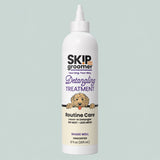
The Detangling Treatment is that same working formula, finally free of the sprayer. It's a leave-in concentrate, balanced to do two things at once: brush into the coat and condition the hair, then get out of the way. No mist, no trigger, no product left sitting on the coat. You apply a small amount to the coat, right where the trouble starts, and work it in with your hands.
That changes three things.
- It goes where the tangle is. Your hands work it into the coat, down at the friction spots, not on top of them. You can feel the rough spot and treat exactly that.
- It's the right fluid for the job. Because it never has to pass through a nozzle, it never has to be watered down — and because it's built to brush in, it doesn't sit heavy or leave residue. It carries the same herbal ingredients we use across all our liquids — hibiscus flower extract for softness and shine, calendula flower extract to calm the skin, burdock root extract to clear buildup, and nettle leaf extract to strengthen the hair. Those ingredients condition into the hair instead of evaporating off it.
- Your hands are in the coat. This is the part nobody markets, and it might matter most. When you apply by hand, you find things. The little knot starting behind the left ear. The rough patch under the harness strap. Every application is a coat check. A sprayer keeps your hand on a trigger, eight inches from the dog. Hands find tomorrow's mat today.
How to actually use it
This is routine maintenance, not rescue. Two to five times a week depending on the coat, a couple of minutes each time:
- A small amount on the coat, at the friction spots — behind the ears, under the collar, the armpits, the base of the tail.
- Work it in with your hands.
- Let it sit a moment, then brush through gently in sections. Pin Brush for most coats. It brushes in and conditions — nothing to rinse, nothing left behind.
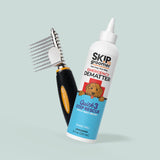
If your hands stop on something solid — a real mat, not a tangle — that's a different job. That's Emergency Dematter Cream territory, and there's no shame in the upgrade. The treatment keeps you ahead of tangles. It was never meant to break up a mat, and we'll tell you that plainly rather than let you find out the hard way.
The shirt I wear because of this

Somewhere in the middle of the returns mess, we made a decision that's now printed on the back of a t-shirt I own: It actually works!
That's not a slogan we bought from a marketing agency. It's the standard we adopted the day we pulled our own product off the shelf. We're a family company going up against pet brands many times our size, and we can't outspend them — we can only out-work them on the one thing that matters: does the product do the job. The spray taught us we couldn't copy the category and be like everybody else. The Emergency Dematter came out of that same rule. So will everything we make next.
Kathy asked the manufacturer a question during the rebuild that I still think about: "If it's strong enough to work, why would we dilute it just so it can go through a sprayer?" Nobody had a good answer. Now you know why we stopped asking the question and just built the answer.
What I want you to take from this
If you take one thing from this post, take this: read the bottle in your hand. Tip it. If it moves like water, it's mostly water — and now you know why. The package made that decision, not your dog's coat.
A concentrate asks a little more of you. Thirty extra seconds. Your actual hands in the actual coat. But that's the trade: the spray is more convenient, and the treatment works. We tried to have both. We have the return reports to prove you can't.
Your groomer will still do the beautiful finish work — that's their craft and we're glad it is. The treatment handles Tuesday. That's the whole idea.
Frequently Asked Questions: Treatment vs. Spray
Didn't Skip The Groomer used to sell a detangling spray?
We did — and we took it off the market ourselves. The formula that actually worked was more than spray nozzles could handle, and the nozzles kept breaking. Rather than water the formula down to save the sprayer, we kept the formula and rebuilt the product as the leave-in Detangling Treatment. Expensive lesson, better product.
Can I put Detangling Treatment in a spray bottle and dilute it myself?
Please don't — we tried the spray route so you don't have to. The formula is built to be worked into the coat at full strength. Diluting it turns it into exactly the watered down product we pulled off the market. A little goes a long way — a small amount covers a friction zone.
Is a detangling spray ever the right choice?
For short, simple coats that don't mat, a light spray before brushing is fine. If your dog has a coat that tangles or mats — doodles, Shih Tzus, Yorkies, any curly or long coat — the tangles form down in the coat where a surface mist doesn't reach. That's the coat we built the treatment for.
How often should I use it?
Two to five times a week depending on the coat, focused on the friction spots. It takes about two minutes. If you're finding mats anyway, the routine needs more days, not more product per day.
Will it make the coat greasy?
Used as directed — small amount, worked in, brushed through — no. It's balanced to condition into the hair without leaving product behind. If the coat feels heavy, you're using too much for that dog's coat. Scale back the amount, not the frequency.
Demat. Detangle. Clean.
Your Dog. Your Way.